Quick Reading Insights
Bite-sized explanations of key cognitive processes & learning hurdles that affect reading, spelling, & language.

MEET THE CREATOR: Ms. Joy
I created Quick Reading Insights as a microlearning series to break down key cognitive processes involved in reading, spelling, and language into simple, accessible insight cards.
With a focus on how the brain processes information during learning, each insight is designed to translate complex concepts from reading science into a clear, practical understanding of common learning hurdles.
This series is for parents and educators who want to better understand why some children experience difficulties with reading, spelling, and language processing — both at home and in the classroom.
I explore key cognitive processes involved in learning, including working memory, auditory processing, visual processing, and rapid automatic naming (RAN), drawing on established research in cognitive science and reading research.
Quick Reading Insights
Each video includes one learning hurdle, one bit of info, and key concepts explained simply.
Learning Hurdle
Hearing vs. Processing
Bit of Info:
A child with Auditory Processing Disorder(APD) can pass a standard hearing test with flying colors and still struggle to make sense of what they hear in a noisy classroom, during a read-aloud, or when directions are given quickly. Their ears work. Their brain’s ability to interpret what the ears send is the hurdle. For families, this often looks like a child who says “huh?” constantly, mishears words, or needs instructions repeated, not out of inattention, but because the signal is getting scrambled between the ear and the brain.
For many families, this is the hurdle that gets mistaken for selective listening the longest, because the child hears just fine in a quiet room, and no one connects the dots until a classroom or busy environment reveals the gap.
Key Concepts
Auditory Processing
Grounded in auditory neuroscience research.
Auditory processing = how the brain interprets and makes sense of spoken sounds
(not the ears themselves, but how the brain understands what is heard).
Auditory discrimination = the ability to distinguish between similar speech sounds (e.g., “pin” vs “bin”).
Signal-to-noise ratio = how clearly speech can be heard and understood when there is background noise.
Central auditory processing = the brain systems involved in organizing, sequencing, and making meaning from spoken language.
Learning Hurdle
Working Memory
Bit of Info:
Working memory is the brain’s mental sticky note the small, temporary space where information is held just long enough to use it. When a child reads a sentence, working memory holds the beginning of the sentence while the eyes move to the end. When it’s limited, the beginning is already gone before they finish, and comprehension falls apart. This is why some children can decode every word perfectly and still say, “I don’t know what I just read.” It’s not a focus problem. It’s a capacity problem, and it’s far more common than most families realize.
At home, this often shows up outside of reading, too. Give a child with limited working memory three instructions at once, and by the time they get to the third, the first two are already gone.
Key Concepts
Working Memory
Supported by cognitive and educational neuroscience research.
Working memory = the brain’s short-term mental workspace that holds and uses information while thinking, reading, or following instructions.
Phonological loop = the part of working memory that temporarily holds spoken or sound-based information (important for reading and spelling).
Cognitive load = the total amount of mental effort being used at one time; when decoding is difficult, it takes up more working memory space.
Executive function = a group of mental skills (including working memory, attention, and flexible thinking) that help manage learning and behavior.
Learning Hurdle:
Phonemic Awareness
Bit of Info:
Phonemic awareness is the ability to hear, identify, and manipulate the individual sounds called phonemes inside spoken words. It has nothing to do with print or letters. It lives entirely in the ear and the brain. A child who cannot hear that “cat” has three separate sounds /k/ /a/ /t/ will struggle to connect those sounds to letters when reading and spelling. This is one of the earliest and most reliable predictors of reading difficulty, and it is also one of the most teachable hurdles when caught early. If a child cannot rhyme, blend sounds, or break a word apart by its sounds, phonemic awareness is the place to start.
At home, this might look like a child who struggles to rhyme, can’t count the beats in a word, or gets confused when you ask them what sound ‘dog’ starts with, even though they know their ABCs.
Key Concepts
Phonemic Awareness
Grounded in reading research from the University of Connecticut.
Phoneme = the smallest unit of sound in spoken language (e.g., “cat” has /k/ /a/ /t/).
Phonemic awareness = the ability to hear and work with individual sounds in spoken words (no letters involved).
Blending = combining individual sounds to make a word (e.g., /d/ /o/ /g/ → “dog”)
Segmenting = breaking a spoken word into its individual sounds (e.g., “flag” → /f/ /l/ /a/ /g/).
Phoneme manipulation = adding, removing, or changing sounds in words (e.g., “say cat without /k/ → at”).
Learning Hurdle
Visual Processing
Bit of Info:
Visual processing difficulties are frequently mistaken for vision problems, but an eye doctor cannot catch them on a standard chart test. A child with visual processing challenges may see letters reverse, rotate, or appear to move on the page. They may lose their place constantly while reading, skip lines without realizing it, or find that white paper with black print feels physically uncomfortable. Their eyes are healthy. The hurdle is in how the brain receives, organizes, and interprets the visual information the eyes send. For many children, this goes unidentified for years because they are told their eyesight is fine, and technically, it is.
For many families, this hurdle comes with a long detour, years of being told ‘their vision is perfect’ while the child continues to struggle, because no one thought to look beyond the eye chart.
Key Concepts
Visual Processing
Supported by cognitive and visual neuroscience research.
Visual processing = how the brain interprets and makes sense of visual information (separate from eyesight).
Visual discrimination = the ability to notice differences between similar letters, shapes, or words (e.g., “b” vs “d”).
Visual tracking = the ability to move the eyes smoothly across text without losing place or skipping lines.
Visual memory = the ability to remember what has been seen (letters, words, or patterns) for later use in reading and spelling.
Reversals = confusion or switching of similar letters or numbers (e.g., b/d), which can occur in early reading development or when processing is less efficient.
Learning Hurdle
Rapid Naming
Bit of Info:
Rapid Automatic Naming, known as RAN, is the brain’s ability to retrieve the name of something it already knows quickly. A child with RAN difficulty knows their letters, knows their sounds, knows their colors, but when asked to name them quickly in sequence, they hesitate or lose their place. This is not a memory problem; the information is stored. The retrieval speed is the hurdle. In reading, RAN matters enormously because fluent reading requires retrieving hundreds of letter sounds and words per minute. When retrieval is slow, reading is slow, and that slowness is exhausting and often mistaken for laziness or inattention.
For many families, this is the hurdle that quietly damages confidence the most because a child who knows the answer but can’t get it out fast enough is so easily written off as not trying.
Key Concepts
Rapid Automatic Naming (RAN)
Grounded in reading fluency research, including the double deficit hypothesis.
Rapid Automatic Naming (RAN) = how quickly the brain can retrieve and say familiar information such as letters, numbers, colours, or objects.
Retrieval speed = how quickly stored information can be accessed and spoken, even when it is already known.
Processing speed = how quickly the brain can take in, interpret, and respond to information.
Naming fluency = the smooth, fast retrieval of familiar symbols or words; important for reading fluency development.
Double deficit hypothesis = a research-based theory suggesting that difficulties in both phonological awareness and rapid naming can significantly impact reading development.
Learning Hurdle
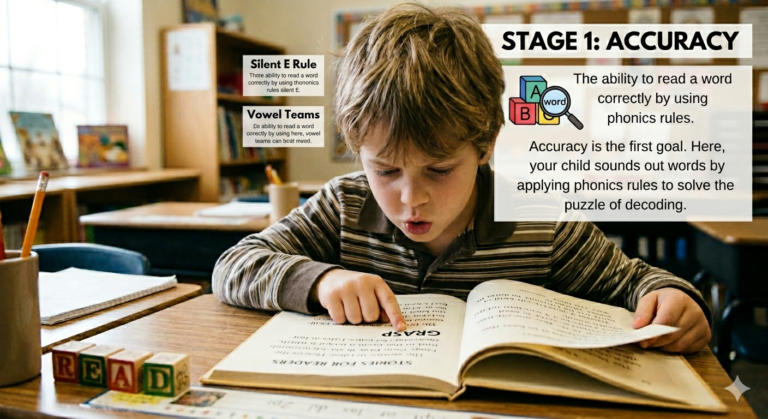
Accuracy vs. Automaticity
Bit of Info:
A child who reads accurately is getting the words right. A child who reads with automaticity is getting them right without having to think about it. Those are two very different places on the reading journey, and confusing them is one of the most common hurdles families and educators face. When a child is still working hard to be accurate, their brain has no leftover capacity to focus on meaning, expression, or comprehension. They are spending every mental resource to decode the word in front of them. Automaticity frees the brain to read words instantly. A child can be accurate and still be struggling. If it looks effortful, it probably is.
At home, this often looks like a child who works hard to sound out every word and gets through the passage, but cannot tell you what it was about because all their energy went to the words, not understanding the meaning of the text.
Key Concepts
Accuracy vs Automaticity
Supported by reading fluency and orthographic mapping research.
Accuracy = reading words correctly, even if effort or decoding is required.
Automaticity = reading words instantly and effortlessly, without conscious decoding.
Decoding = using knowledge of letter-sound relationships to sound out words.
Orthographic mapping = the brain’s process of storing written words so they can be recognised instantly in future reading.
Reading fluency = the combination of accuracy, automaticity, and appropriate expression; fluency develops when reading becomes effortless enough to support comprehension.
THE RESEARCH BEHIND THE INSIGHTS
Supported by Science
Every insight in this series is grounded in peer-reviewed research and evidence-based literacy science. The frameworks, terminology, and guidance shared across these 6 insights draw from published findings in
- Northwestern University: Language, Literacy & Auditory Neuroscience Research
- University of Connecticut: Reading Research Center
- Proceedings of the National Academy of Sciences (PNAS): Cognitive & Educational Neuroscience
“When families and educators understand the science of reading, they become the most powerful intervention a child can have.”
These insights are just the beginning. Spelling Sense is coming soon, a structured microlearning series that gives families practical spelling lessons grounded in the science of reading.
— MS. JOY, Curator of Quick Reading Insights
These insights are educational in nature and are intended to support understanding of reading and processing challenges. They do not constitute clinical diagnosis or intervention. Always consult a qualified specialist for individualized support.